Developing my creative practice in 2023

I am delighted to share that I have been awarded a Developing Your Creative Practice grant by Arts Council England. This grant will support me to research and write my next poetry book, CYMA, during 2023.

CYMA will investigate the military histories, climate futures and sensory ecologies of a specific site in Norfolk, through a neurodivergent/disabled lens. As part of the project I will be trying new research and writing techniques, and working with other creatives to help me find innovative ways to share the poems with audiences on the page, on stage, and online.

I have been scoping this project since 2018, and it’s hugely exciting to have the opportunity to bring this long-held dream to reality. I will be sharing my reflections as the project progresses in future posts. Stay tuned.

the other body is 1!

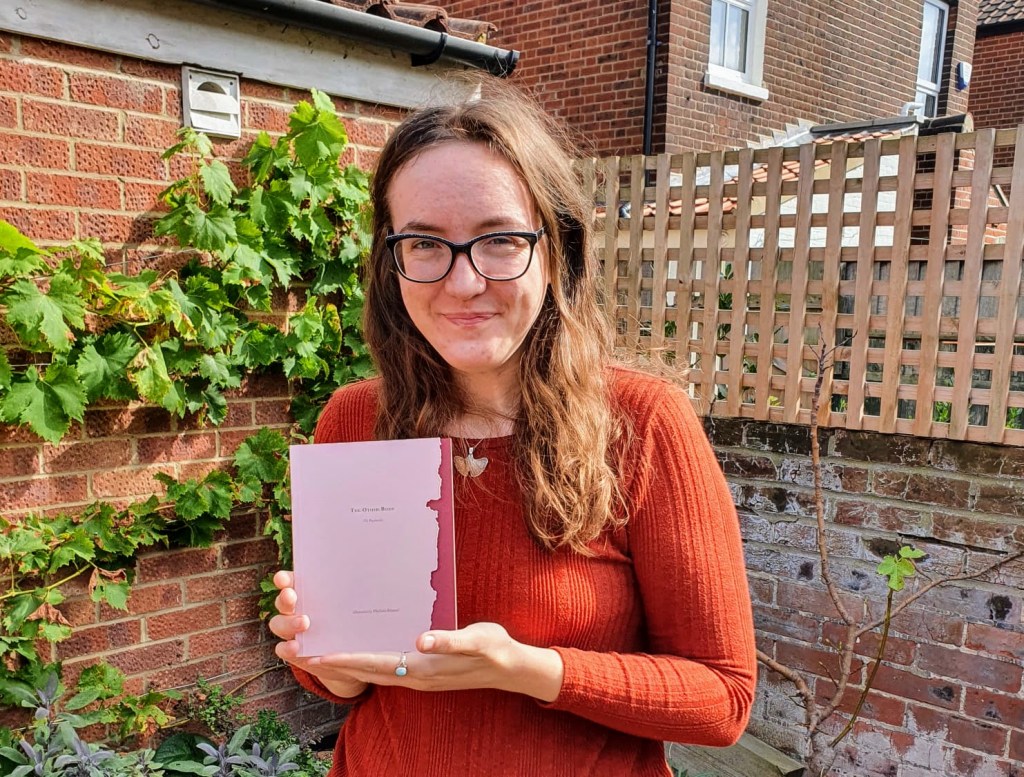
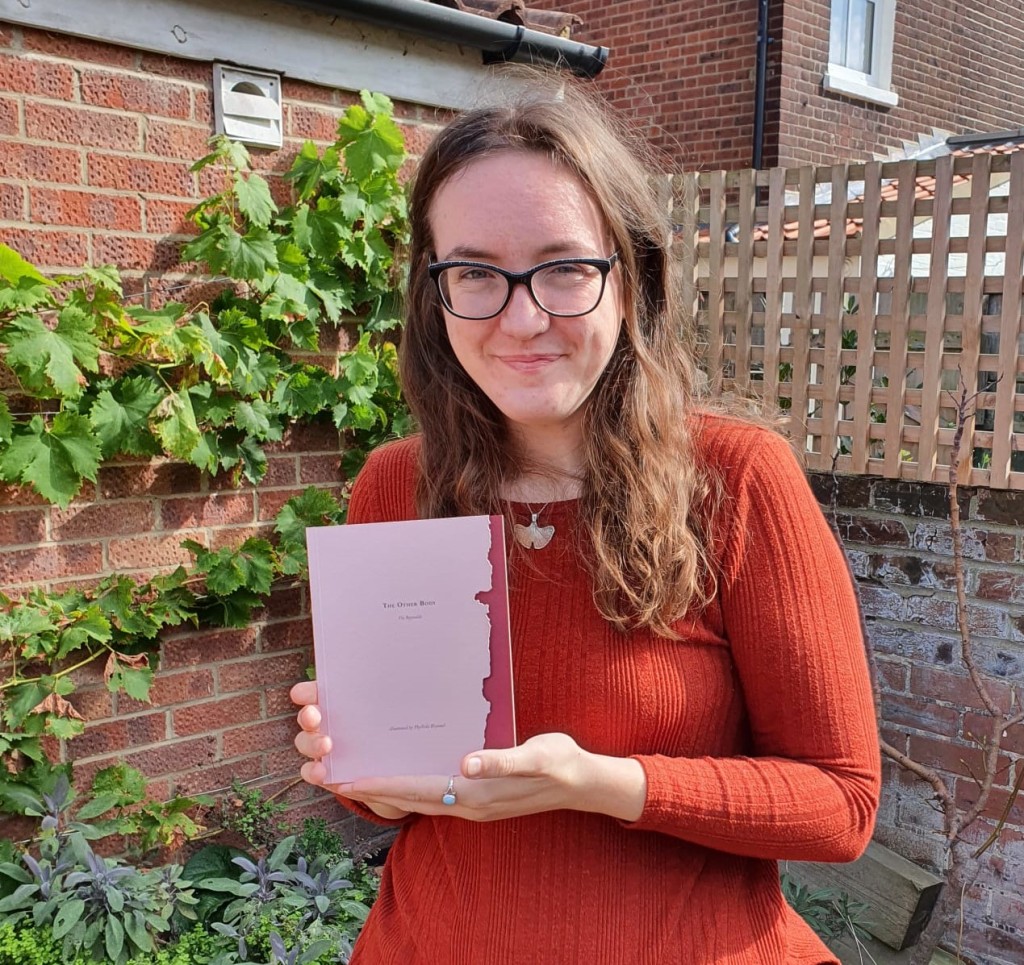
It’s been a year since my debut poetry pamphlet, the other body, was published by Guillemot Press, and I’m celebrating its birthday! We launched it on 14 October 2021 (video here). Here I am a little over a year ago, on the day I unwrapped my parcel of author copies and saw my book for the first time.

Flo Reynolds holds up a copy of their debut pamphlet, the other body (Guillemot Press, 2021). The book has a pink cover that has been designed to look like it has been nibbled by critters. Flo is a white person with long brown hair, wearing an orange top. They are standing in front of a brick wall and greenery.
Holding the other body in my hands for the first time. Image copyright (c) Perry Andrews, 2021.

It still feels surreal to have a physical book with my writing printed in it, especially one with such a beautiful design and illustrations by Phyllida Bluemel.

the other body was about five years in the writing. Not every poem in there was five years old when I submitted it to Luke and Sarah at Guillemot in late 2019, but it took that long for the ideas to coalesce, the poems to be written, the line by line editing, and then putting it into pamphlet shape.

I learned a lot from the process and it still fascinates me that the secret ingredient for any creative project is time. It can be a fine balance between acting quickly to keep momentum, and taking enough time for the project to emerge. Then, at the end, there’s the breathless, heart-swelling moment when you know it’s ready, and it’s time to stop working on that particular project. Time moves strangely in the writing.

Following the other body I’ve been hard at work on other projects. I have another pamphlet that is completed, and I’m working on my third. The latest pamphlet is born out of my interest in textiles and the teachers who taught me to knit, to spin, and weave when I was a teenager who thought they might have a career in design in future. And in the background I am planning my largest project to date, my debut poetry collection CYMA. I have scoped out the project over the last couple of years and I’m hoping that 2023 will be the year I can begin in earnest.

No matter the new projects, I still find myself sometimes taking my copy of the other body down from the shelf, reading it, or even just holding it. Wherever my writing life takes me, tob (as I call it for short) will always be my first published book. I’m amazed and delighted that it’s here, it’s beautiful and it’s real.


If you’d like to buy a copy of the book you can do so via Guillemot Press. To stay up to date with my writing, why not subscribe below or add my site to your old-skool RSS feed.

Watch the launch of the other body

Back in 2021 I launched my debut poetry book, the other body, and I’m delighted that the launch is now available to relive and enjoy on YouTube.

It’s always nerve-wracking launching a book, and given the Covid-19 pandemic things were even stranger. We decided to launch online and to my surprise it really worked. Somehow Luke and Sarah at Guillemot Press managed to make the event feel intimate and creative, even though it was on Zoom! Big thanks to them both, as well as my co-launchers Petals and Clarissa, and the live audience who made it such a fun event to be a part of. I had some beautiful questions to answer from the audience and it was a pleasure to present my work in this way.

You can watch the event below or here – I hope you enjoy!

I wrote the book over the course of several years from about 2015. In it I explore ecology and how we as humans relate to different beings, including compost heaps, snails and slime moulds, to name just a few. At the heart of the book is the titular sequence of short, playful lyrics, although during the event I also enjoyed reading a couple of the longer single poems, including a real tongue-twister.

Over the past nine months it has been really exciting to see readers engage with my work in book form for the first time. The launch event was definitely one of my favourite readings I’ve ever done – though it won’t be the last!

I hope you enjoy the video of me reading of some of the poems. the other body is available for purchase via Guillemot Press. If you’d prefer a signed copy, I have a few copies left so please contact me to let me know you’d like one. I can ship anywhere in the world. And stay tuned for my online store coming soon, where you can purchase my work and resources for writers… watch this space!

the other body reviewed

Recently my debut poetry book, the other body, has received some good reviews. I’m really glad to know that it has connected with readers so far, and it’s fascinating to see the different facets and interpretations that people are picking up on.

Reviewing the other body on his blog, Billy Mills notices the search for a sense of wholeness, and (to my delight) engages with the use of Welsh language and myth in the book. Billy writes:

Reynolds’ work here is profoundly ecopoetic, an attempt to integrate the world in verse. […] This is my first encounter with their work, and I look forward to more.

You can read the rest of Billy’s review here.

Jennifer A. McGowan remarks on themes of bodies, love and divinity in Sphinx. She writes:

These are natural, scientific bodies, but the reader feels (at times uncomfortably) as if it’s their own body, too. The ‘you’ of ‘Hello Stranger’ becomes the ‘stranger of clay and cloth’, attempting to love — to make love, to construct it and examine it — in the forest. Doing so, the poet draws the reader (‘you’) into her poetic ‘I’; acknowledges the reader as an other, necessary, body.

You can read the rest of Jennifer’s review here.

Big thanks to both Billy and Jennifer for taking the time to share their readings of my book. the other body is available from Guillemot Press, and if you’d like to read it you can buy it here.

the other body out in the world

My debut book of poems, the other body, is now published and available from Guillemot Press.

Written in conversation with snails, slime moulds and spookfish, the other body sees me explore inter-species relationships and the ways in which the human body is inextricable from worlds beyond its perception. By turns playful and contemplative, the central sequence coalesces and disassembles into something like love poems, equally for creatures embodied in “tissue + rib + aura” and those whose forms are wondrously different.

The book has been beautifully designed and illustrated by Phyllida Bluemel, and features a ‘nibbled’ Tintoretto Ceylon front cover. Huge thanks to Phyllida and to Luke and Sarah of Guillemot for bringing the book to life!

I will be reading from the other body at a joint launch event with Petero Kalulé (petals) and Clarissa Álvarez on Thursday 14 October 2021. The event is free and takes place on Zoom. You can register your attendance here.

Project update: listening, waves, unfurling

Back in 2019 I wrote about my hopes for a new poetry project, which I called “that listening space” for the time being. I now call it CYMA, for ease, and as the project evolves. I thought I’d share an update on where scoping the project has taken me to date, and my plans for the next stages of researching and writing CYMA.

CYMA (swell, wave, curve, unfurling of young cabbage leaf) will be a poetic exploration of spatial sound in different media: the body, urban space, and the ecology of a richly historied coastal saltmarsh. The project is inspired by and will take the forms of the sonosphere – bubbles, fields, and waves of all kinds – investigating environmental sound as a way of knowing and voicing, and how listening remains possible when hearing is frustrated or silence pervades. The project will build on my abiding interests in bodies, ecology and systems, and challenges me to find ways to privilege the aural over the dominant visual in my writing and thinking.

This pandemic year has been both helpful and unhelpful to my process. Reduced traffic noise has made my urban listening more possible and pleasant; at the same time, I have been unable to get to my primary research site for months at a time. I’ve discovered the works of so many artists, those living and those who have gone before, engaging with listening in their work; it’s been impossible to meet fellow writers and researchers as usual. This feels particularly important for this project, which was begun in 2018 after a conversation with my friend Robbie about the work of Pauline Oliveros, and I’m really missing being surrounded by creativity and sharing ideas and processes with others.

That said, I have been able to attend online events that I wouldn’t usually have been able to get to, which has been fantastic. I’ve also taken solace in reading and writing more than ever before, returning to old favourites and reading genres that I wouldn’t usually choose. Reading about the fields of sound art, field recording and composition has been eye-opening. I’ve realised that it’s no mean feat to learn about a whole new discipline. Like everyone else, I’ve had no choice but to immerse myself in a sense of strangeness and disquiet. At least this feeling is exactly what first made me want to write about sound, space, my particularly eerie site and its military and surveillance history.

In terms of output, I’m generating a lot of notes as I scope out the project. When I begin the writing proper, this project will be very challenging and a real chance to step up my practice and skill. I will have to develop new methods and rhythms of researching, and to return to old ways that I haven’t exercised in a while. I will look at history, ecology, geology and physics, and use site specific writing, listening practices, field recordings and imagination to generate material.

I might also instigate a parallel practice of writing “letters to S” – a cipher standing for sine waves/ sound/ site/ signal/ space/ spirit. In these letters I will write to my subject about my process, research findings, as well as the “noise” of everyday life, and then “post” each letter into a sealed box. The letters will form a secret diary of the project that is secret even from myself, once I’ve forgotten what I’ve written in them. At the end of the project these signals will be received and incorporated into the final output(s) in some way.

Developing a conscious writing practice 2: writing projects

In the first part of my series of posts about developing a conscious writing practice, I looked at the benefits of reflecting on one’s writing practice, and how I’ve come to be more aware of my own writing rhythms and productivity. In this second part I’m going to think about how I’ve gone from writing by accident to looking at my practice as a series of projects, and what the benefits of this approach have been. 

This is an understanding that I’ve come to over the past few years as I’ve completed my first two major manuscripts. I’m now taking this learning forward for my next writing projects. This is something I wish I’d known about sooner in my career, and part of the writing life that still goes a little under the radar. My hope is that reflecting on this learning will not only help me make sense of my own practice, but might offer some things for fellow emerging writers to experiment with, too.

From accident to intention

I wrote my first collection of poems over a period of roughly 5 years. Some of these will be coming out in a pamphlet next year. Both of these books happened incrementally and almost by accident. I wrote individual poems on the topics that interested me at any given point. I tried putting pamphlets together every now and then but none of them came together in a way that felt satisfying. I was writing without a goal or a plan. I really enjoyed writing in this way, wrote some poems that I’m proud of and lots that need more work to this day, but it took a long time to accrue enough finished work to actually make a book – and making books has been something I’ve been driven to do since childhood. 

Eventually I had enough poems of good quality that I could finally recognise the three main themes/features of my work over this five year period. These are an interest in natural systems and a kind of self-conscious spatial awareness (influenced by writers and thinkers including Sara Ahmed, Simone de Beauvoir, W. S. Graham, Donna Haraway, Daisy Hildyard, Bhanu Kapil, Denise Riley, Anna L. Tsing, Isabel Waidner), which I put into mostly short, irreverent lyric forms. I realised I’d been writing about the same ideas and experiences for a long time, and I had started to do so in increasingly similar forms. This core of poems was the basis of my book. Crucially I started to write new poems to fill in the gaps between the existing ones. Suddenly I was writing by design – I had a topic, I had a form, and I knew what would be either side of each new poem. Almost imperceptibly I had gone from writing poems to writing a book, from accident to intention, and from individual pieces to a project.

Writing projects

My professional background is in project management of cultural programmes, but it stil felt like a lightbulb moment when I realised I could treat my writing like a project. While there are many different approaches and definitions of projects out there, in my experience they all have several key features in common. These features are:

  • A project is undertaken in a given amount of time. We know that writing takes time, but writing in a project-based way means that we need to be aware of this time. What happens if we make an educated guess about how long this poem/story/book might take to write? How can we structure our writing time to get the most out of it?
  • A project involves work. We know that writing isn’t always pure unbridled fun (though when it is, there’s nothing like it). It takes work: we have to show up, sit down, and get the words onto the page, and we have to do this around all the other things life throws our way. But there are other kinds of work that go into writing, including research and thinking time. These count as work too, and being aware of them means we’re thinking about writing in a realistic and holistic way, as a practice rather than a discrete activity. 
  • A project needs resources to make it happen. On a mechanical level, writing needs certain basic resources – pen and paper, a laptop and internet connection, whatever works for you. But there are other, more ephemeral resources that go into our writing. For my projects the big ones are always research materials (books, library visits, visits to particular outdoor sites), feedback (being able to talk my ideas through with other writers) and time. Resources can also include professional development, including mentoring sessions, membership to writer’s groups, or attending workshops. When we think about our writing in terms of projects, it helps to figure out what we’re going to need to make this project happen, how much it’s going to cost, and where that money will come from, whether that’s our bank account, a funding application, or the goodwill of friends, family and strangers. 
  • At the end of a project, there is something new, usually an output and/or some kind of change. When you’re working on a project, you need to know what you want to have at the end of it. While this could be a full draft, or a publishing deal, it can also be something in its earlier stages, e.g. a body of research or just a clearer idea of what you might do next. This has been the biggest shift in my thinking – designing my end point (whatever it might be), and then working to meet it. This point also asks us to tap into our bigger motivation. Why write at all? What do I want my work to say? Who am I trying to reach? Why does writing in this particular way serve that purpose? What is my unique set of concerns as a writer?

All of this is to say that a writing project isn’t just the manuscript or finished work itself. It’s also everything that goes into it. By thinking of writing in project terms we go from seeing writing as a single activity to understanding the many different processes and resources that form part of our creative practice. Once we’ve done that we can make the best of them, look past what’s on the page to understand our practice as writers in a more holistic way, and carry on growing and improving. 

The benefits of writing projects

This shift from poems to a book project didn’t happen consciously or overnight, but as soon as I caught up with myself and became aware of it, my productivity soared. I found I could crack out a first draft in just one writing session, and because I had a clear idea of what I wanted to write I had less editing to do afterwards. I was fitting my ideas into a shape, rather than finding a shape for my ideas. It wasn’t a better way of writing, but it was quicker, more purposeful, and more consistent. And because I had a clearer idea of my own intentions and processes, I was able to finish a manuscript and take that next step up as a writer. 

Understanding that writing is work has also meant that I feel more able to go easy on myself when writing isn’t easy. I used to get home from a full day’s work and expect myself to be creative and make leaps and bounds on my manuscript. The truth was I needed dinner and a walk before I could think of doing anything else. Now that I’m more honest with myself about the fact that writing is a form of work, I let myself take that stroll around the block to reset after the dayjob, I don’t feel bad about it, and it actually helps me get in the writing zone more quickly and often. I had also been doing a lot of looking sideways, seeing what my peers were publishing at what age, and putting a huge amount of pressure on myself to conform to other people’s writing trajectories. Understanding my writing projects better means that I can give each project its own timeline, and feel more comfortable that yes, it takes as long as it takes. My job is to research and write each book as well as I possibly can, not to keep up with the Joneses. 

All of this means I’ve experienced a huge confidence boost, and this in turn means that I’m more able to talk about my work before I’ve finished it. I’ve always been fairly secretive about my writing, which has made it harder to solicit feedback from friends and writing groups. Now that I can discuss my processes, my ideas and how I’m planning to meet them, it feels easier to share my work with other people. I have more fulfilling writing friendships and I can even start to apply for funding, residencies and other opportunities. 

So there you have it. While talking about project management in terms of writing doesn’t sound particularly glamorous, in my experience it has been a freeing process that has opened up my own creativity and my ability to take my work out into the world. I hope it might do the same for other writers out there.

See more about developing a conscious writing practice.

A tale of two (or more) stories: a photo essay

It’s the last day of the month, which means it’s time for the latest in my Adventures in Reading series of essays. This time, in “A book holds many stories” I explore how books as physical objects hold stories beyond the printed word. I mix words and photographs, taking inspiration from Chirodeep Chaudhuri and Jerry Pinto, with Caroline Bergvall and SR Ranganathan as other useful waypoints. This photo essay has been a fun and poignant opportunity to revisit the community of my own book shelves, as libraries remain closed and under threat around the world, and as social distancing continues.

You can see the photo essay here. You can read my previous Adventures in Reading, and sign up for future Adventures, too.

Developing a conscious writing practice

Around June-July for the last three years in a row, I’ve had a really productive writing time. In the space of a few weeks each summer, I seem to make more progress than I would usually do over 6 months, in terms of both ending up with a near-complete manuscript or two, and of improving and developing my writing. The second of these is less measurable, but still noticeable; I feel simultaneously tired and energised from being in my stretch zone, and I experience breakthrough moments, suddenly finding solutions to problems that I’ve been struggling with for years. From August through to October I have less creative energy, but I feel motivated when I look back on the progress made in June-July. I have another month of intensive writing towards the end of the year, usually in November. These three productive months of the year are a hugely exciting time to be writing. The rest of the year I carry on researching, making notes and editing, and looking forward to the next of these biennial writing bursts.

I share this for two connected reasons. The first is that after ten years of taking my writing seriously, I finally understand more about my working style and practice. This knowledge has snuck up on me over the years, and now that I have it I am able to start thinking more consciously about where my writing will take me next. The second reason is that in my experience as a writer, reader and producer of literature programmes, it can sometimes feel difficult to talk about writing in a pragmatic way. Being aware of the skills and working styles that writers have makes it easier to do the business and administrative side of a creative career, e.g. approaching agents and publishers, applying for funding or paid positions. Knowing your strengths, weaknesses and preferences also helps to maximise the time and effort you can devote to your writing, and suggests other approaches to experiment with.

For these reasons I find it increasingly valuable to discuss writing as a “practice” – something that requires action, that can be developed over time, and that changes as we change. Other creative disciplines and formal study of creative writing teach ways of reflecting on one’s writing, through presenting sketch- or notebooks for feedback, and writing critical reflections, artist statements and self-evaluations. But if, like me, you haven’t had such training, or if you feel outside or on the edges of a creative community or tradition, it can take time to find a way to articulate your practice, whether that’s talking about your broader concerns or themes, or the daily minutiae of balancing writing with earning a living and caring for ourselves and others.

At the same time, the mythology around writing persists in inviting us alternately to believe that it all comes down to “just sitting down and writing” or experiencing a sudden flash of “inspiration”. Media coverage of the latest bestsellers still deals in sensationalist stories like The Prodigal Young Author Who Has Achieved It All By The Age of 22, or The Established Author Who Wrote A Stunning New Book At The Very Same Time As Going Through A Momentous Life Event. The truth is that it’s usually a mix of hard work and inviting in ideas; that everyone’s development, circumstances and preferences are different, and that the unromantic stuff – like getting paid, remembering to put the bins out, and taking time off to avoid burnout – has as much impact on one’s writing as do talent, experience and training. And just as a book so often becomes its true self only during redrafting or editing, so too do we sometimes understand ourselves as writers only after the book is finished or the Momentous Life Event has passed.

I’m now at the stage where I can start to articulate my practice more usefully. While writing my artist statement has allowed me to put into words the ideas that grab me, the techniques and processes I use and which projects I’m working on now, I also want to share the quotidian elements of my practice. I used to enjoy those magazine articles about which items celebrities keep in their handbags, and now I love to hear about other writers’ ways of working, gleaning tips and things to try from conversations, interviews and events. So, in a spirit of reciprocity, I share that I have three good writing months in June, July and November each year; that I have self-imposed a social media ban on writing days, because I know from experience that if I scroll through Instagram before sitting down to write I will be stymied by a mixture of impostor syndrome, envy and self-doubt; that walking somewhere green always helps me come up with new ideas, and that I use the dictaphone app on my phone to record the ideas that arrive while I walk; that I am still learning from other writers and artists how to translate research into a narrative (events with Megan Bradbury and Michael Donkor have helped me here, as has reading Bhanu Kapil, Hannah Dawn Henderson and Sophie Collins) and how to balance personal and wider perspectives (for this I am reading Tessa McWatt, Meena Kandasamy, Han Kang in Deborah Smith’s translation, David Wojnarowicz); that I am still learning to take my time, to look back and realise how far I’ve come, to look ahead and put into words where I want to go.