Last week I had the pleasure of taking part in the European Poetry Festival 2025.
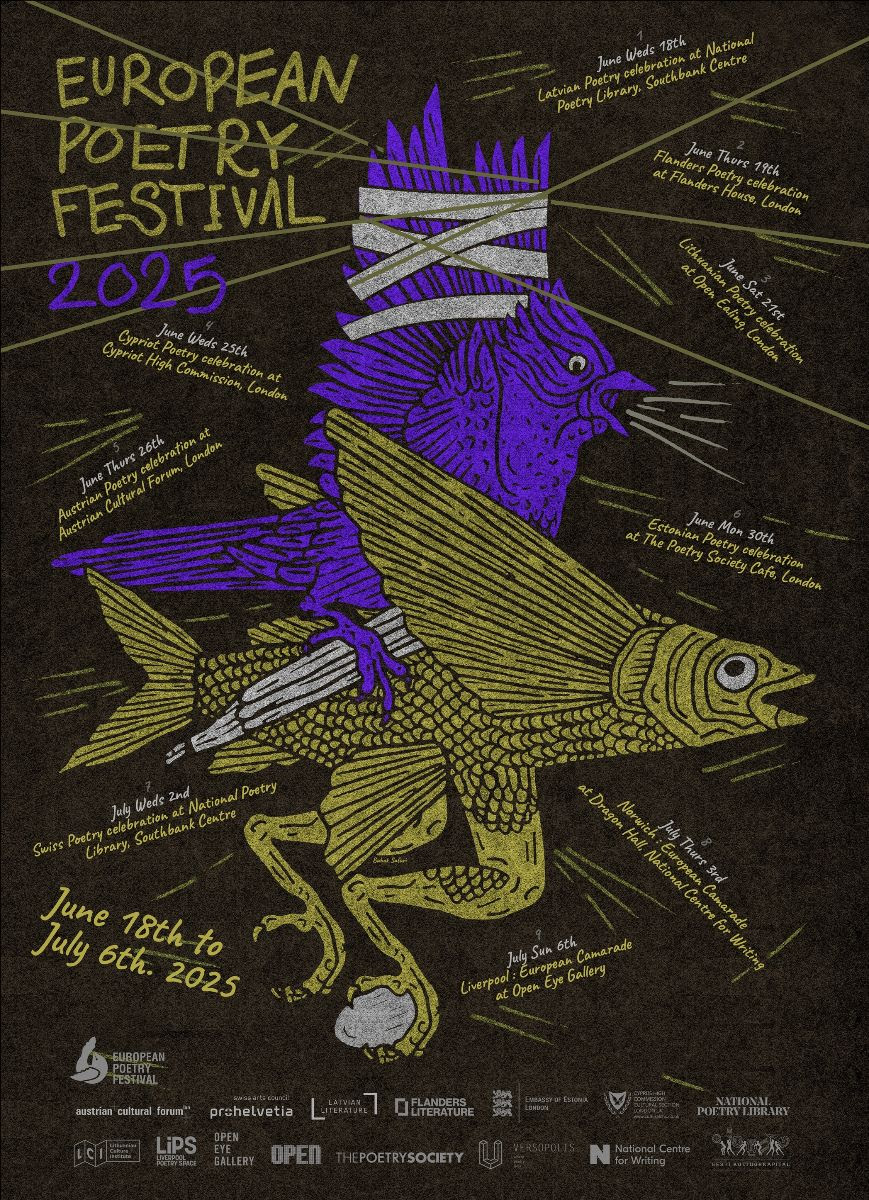
The Festival is curated by S J Fowler in partnership with several cultural institutes and venues across the UK. Writers from across Europe and the UK are paired and invited to present a new collaborative work in a series of live events.
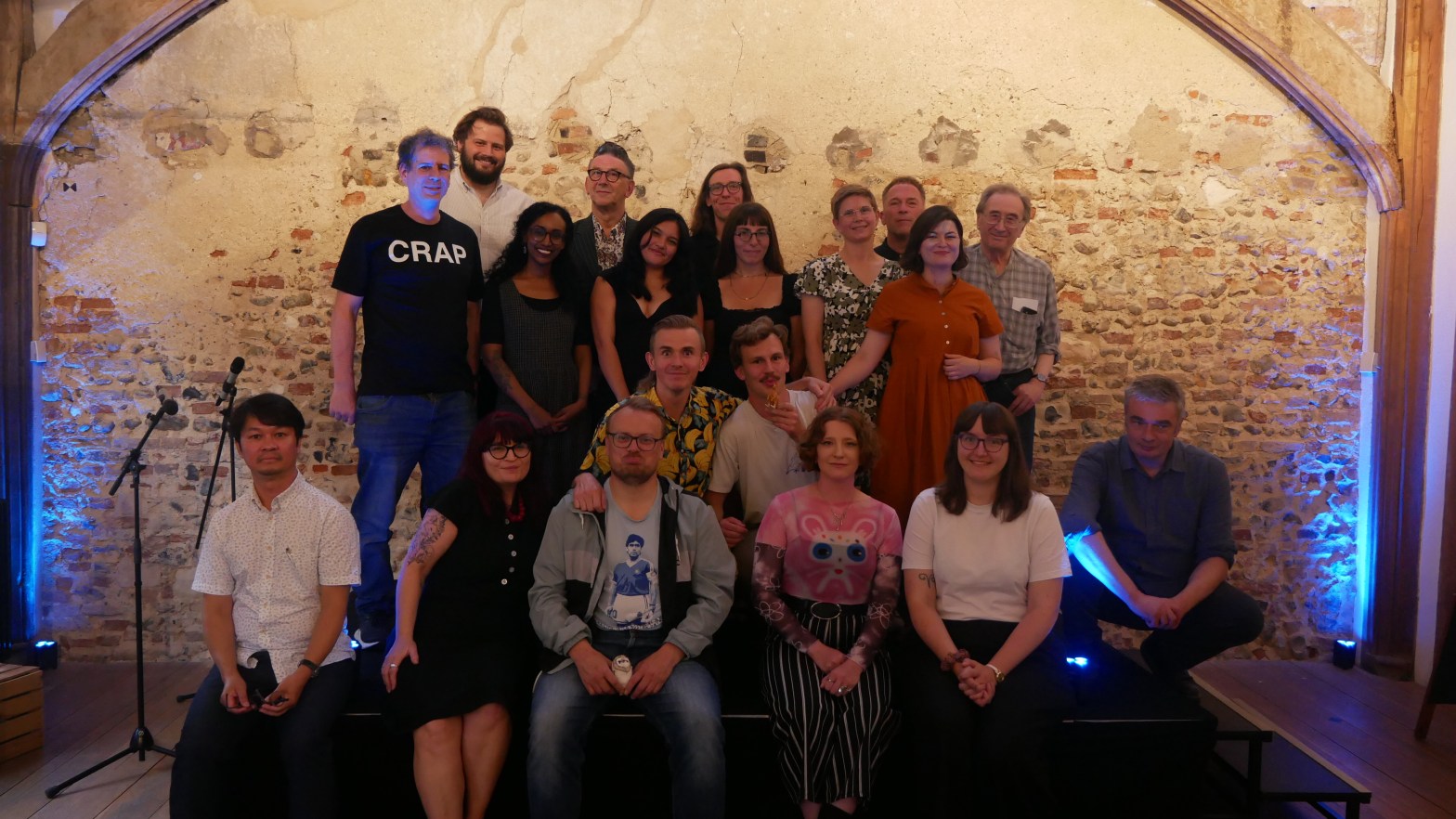
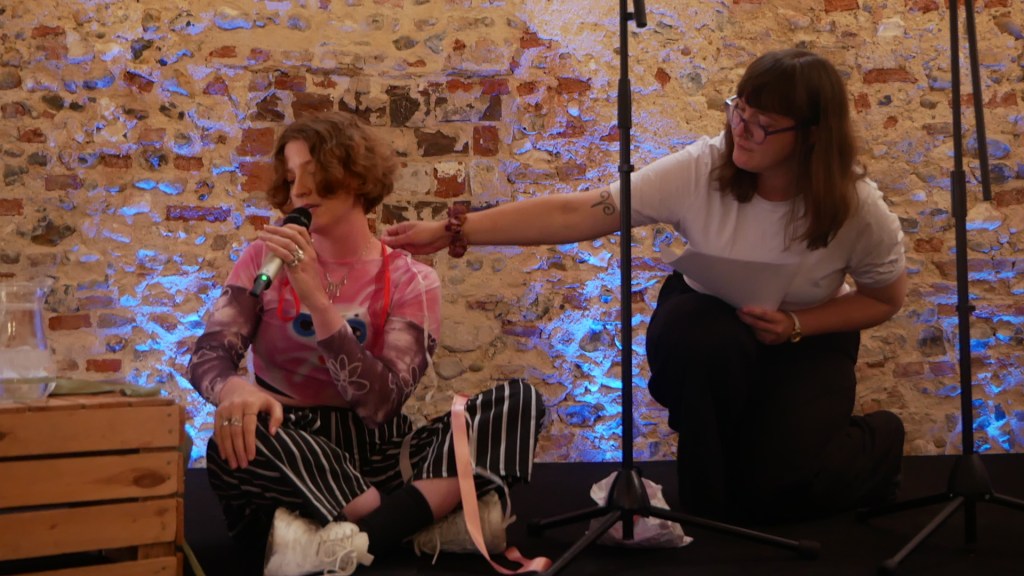
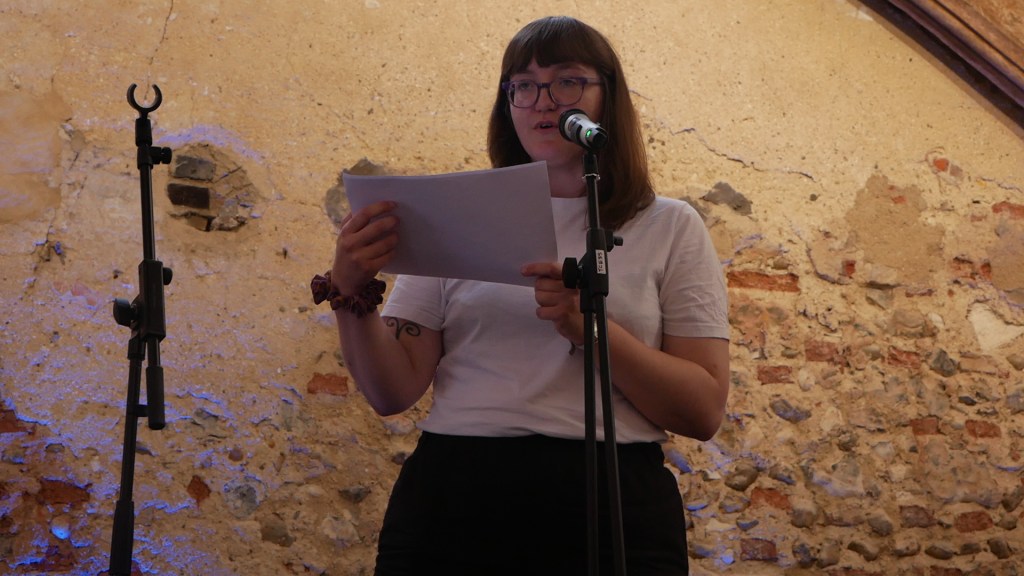
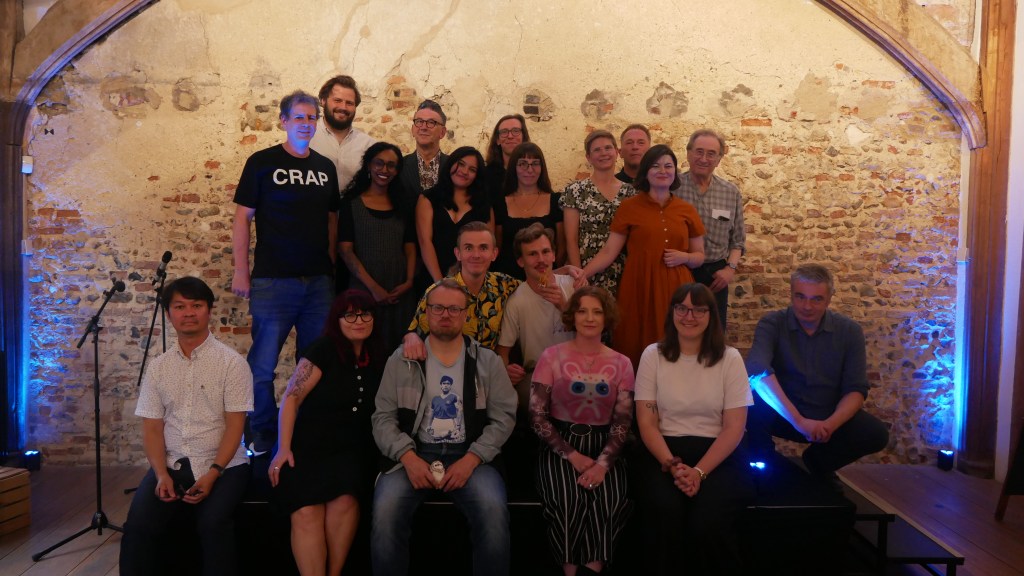
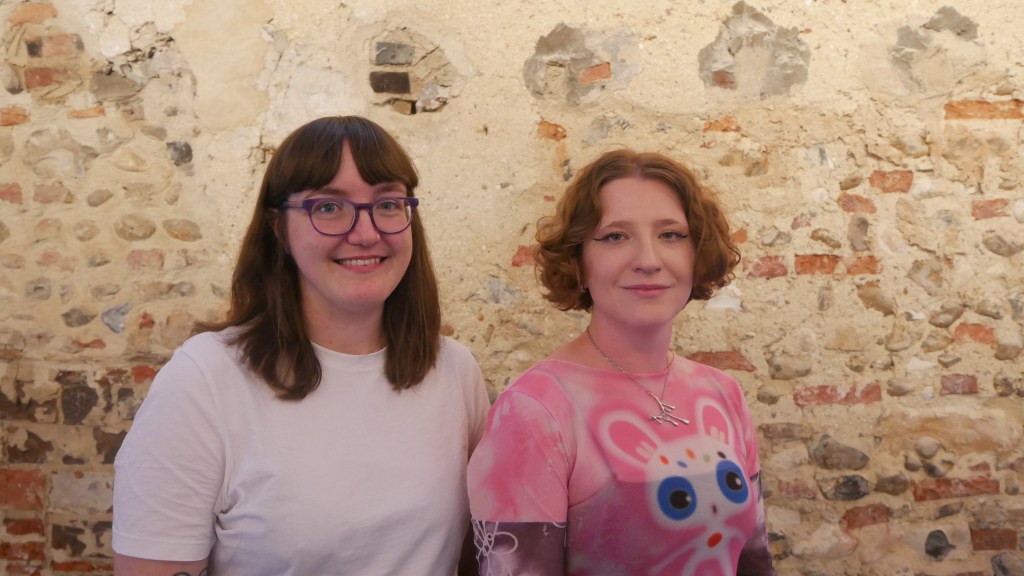
I was paired with Petra Palkovacsova, who runs Femmesocial Press. Over a couple of weeks we worked on a new piece about bodies, minority languages and how we wear our histories. We performed as part of the Festival’s Norwich leg, at National Centre for Writing alongside a fantastic line-up. While the poem was prepared in advance, we improvised our performance.
I’ve collaborated with several other poets over the years, but this was the most time-constrained collaboration I’ve done, and also the only one where we had to perform the results! It was a fantastic experience and I’m hugely grateful to Petra, Steve, the other poets and our hosts at NCW for the chance to be a part of this fantastic event.
I had a brilliant time recently talking to Elspeth Wilson about my freelance practice as a writer. Our conversation is now available to read over on Elspeth’s Substack, (Neurodivergent) Notes on Writing.
I really recommend subscribing to it if you’re interested in the creative process, access and equality in the arts, and how writers actually get the work done. There are some fantastic writers who I really admire featured on there, so I am hugely excited to be in such company!
We talked about whether and how to address neurodivergence in creative writing, how it can impact on the creative process, and how the publishing industry could be more accessible.
Plus I took the chance to shout out about my friend and mentor Sascha A. Akhtar’s recently reissued poetry collection, The Grimoire of Grimalkin, which completely changed my understanding of what poetry can be and do.
Huge thanks to Elspeth for this wonderful opportunity to share what I’ve learned over the years and to connect to fellow neurodivergent and disabled creatives. We have a brilliant and growing community that it is a joy to be a part of.
And don’t miss out on Elspeth’s debut novel, These Mortal Bodies, which is out soon and available to pre-order now!
I’m really exciting to be reading twice in the coming months.
First up, I’ll be headlining Volta poetry night in Norwich on Wednesday 4th June 2025. The reading will take place at The Holloway on St Benedict’s Street. I’m excited to go to this new venue and bookshop for the first time. There are open mic slots available and my co-headliner is Jane Wilkinson. I hope to see you there!
Secondly, SJ Fowler kindly asked me to take part in this year’s European Poetry Festival. I can’t wait to read a new collaborative work at the event on Thursday 3rd July 2025. This one takes place at my old friend, National Centre for Writing. The line-up is incredible, featuring local poets collaborating with poets from across the continent. Don’t miss it!
Together, we’ll consider how life events, great and small, can shape our poetry – and how, in return, poetry may reveal the shapes of our lives. We’ll try different ways of writing life as it happens, before returning to and reworking our texts with the benefit of time.
We’ll explore how we might record our contemporary world through documentary poetry, and how we might connect personal stories to deeper histories.
I’ve selected the work of many wonderful poets to guide us. We’ll look at works by Bernadette Mayer, M. NourbeSe Philip, Sean Borodale, James Schuyler, Nat Raha, Frank O’Hara, Alice Oswald, and Nicole Sealey, to name a few.
In all my teaching I offer a range of ways in, with plenty of options to explore further or come back to an exercise when you have more time and energy.
By the end of the course, you will have developed a toolkit of techniques to enrich your poetry now and throughout your writing life.
The course is open to poets of all levels and takes place online. There are no live chats or seminars, so you can join in from wherever you are in the world, on your own time. It starts on Tuesday 21st January and booking is now open!
Courses at the Poetry School often sell out quickly, so I’d recommend booking sooner rather than later. Concessions are available.
I’ve been waiting for a sunny day to take a picture with my new book, girlhoof. It’s taken a while! But while the sun hasn’t been out much in this corner of the UK, girlhoof very much is. You can order your copy now from Salò Press.
Every book has a story behind it, but girlhoof‘s was by no means straightforward. I published the first of these poems in a magazine eight years ago, when I was in my mid twenties. A lot has happened since then, and it still feels amazing that I got it over the line at last, with the help of Sophie and Andrew at Salò of course.
It all started when I broke my elbow, and suddenly I couldn’t ignore my body. Every movement of my right arm was painful. I could only type slowly, and had to write with my left hand for a few weeks. My body had inserted itself into my writing, whether I wanted it to or not. At that time in my life I was immersing myself in books by queer and women authors, many of whom explored issues of the body in their writing. I thought that I could do the same, perhaps. It seemed worth exploring.
The central sequence of girlhoof was born from that impulse, and accrued over the next few years whenever I felt I had an urgent subject. The poems took different forms depending on the body part in question. ‘ankle’, for example, uses terse, short phrases that I tried to connect together into a knotty, knobbly structure. In ‘skull’ I sought to emulate the strange unspoolings and sudden breaks in the narrative of my thoughts after a serious concussion. Though thematically linked, I found I could be adventurous in my choice of technique across the sequence.
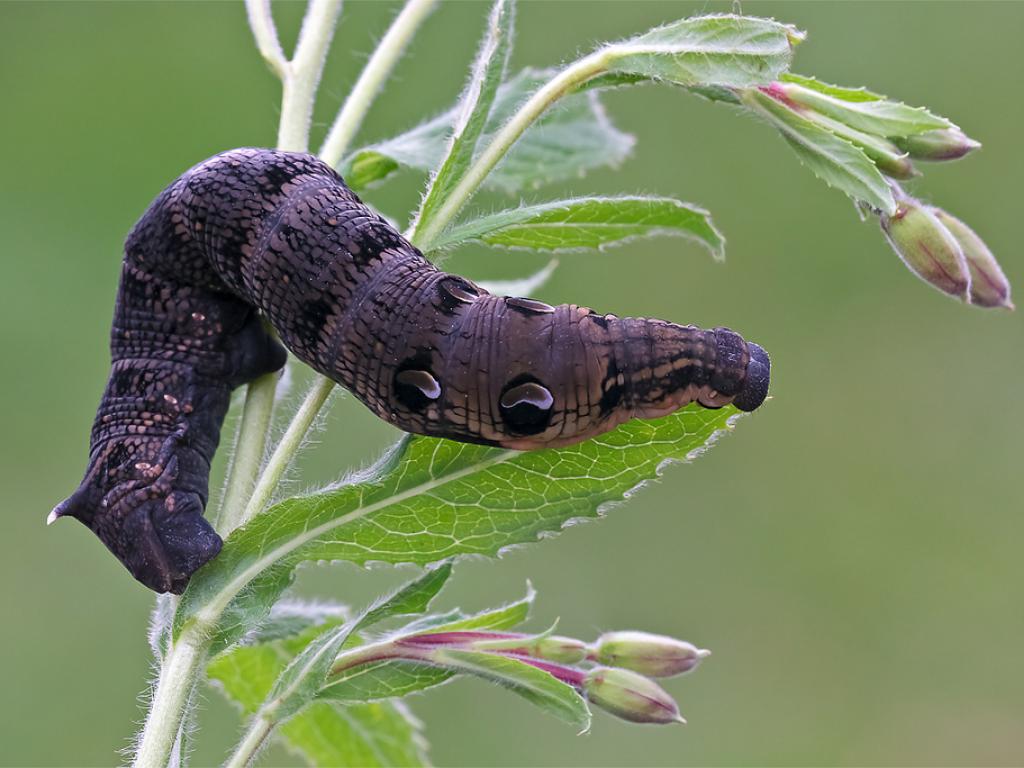
Other unrelated poems started to gel with the central sequence. I found myself voicing female robots, addressing hawkmoth caterpillars, attempting a communitarian ghost poem. Some were published in magazines, others were rejected. It took years for the final line-up to settle. I sent early versions of the girlhoof manuscript to publishers a couple of times, and it was ignored, longlisted and shortlisted, but always sent back eventually. The editors told me each time what I already knew: it wasn’t ready yet.
Much has been said about rejection, how necessary and inevitable it is for writers, and I don’t have much to add to that here. Suffice to say that after a couple of submissions, I thought girlhoof might be unpublishable. I had sent it to presses I didn’t have any existing connection to, being worried to send to friends and editors I knew, in case I shouldn’t be writing poems like these, poems of the body. Some days I thought it might be too strange, others too hackneyed. Or perhaps it was too arch, but also too serious. Surely it was too experimental, I said to myself often, but on bad days it also seemed too obvious. Whatever was wrong with it, I didn’t seem to be able to make it right. I put the manuscript in a holding folder on my computer for several years, and forgot about it.
The cover of girlhoof. Cover design by Salò Press. Cover image by Jazzberry Blue.
At the end of 2023 I saw that Harry Josephine Giles would be guest editing the issue eight of Propel magazine, and, as a longtime admirer of her work, I decided to send in some poems. To my surprise and delight, Josie selected ‘poltergeist’, the poem I had always intended to include at the end of girlhoof, but which had always been rejected by magazines in the past. This vote of confidence in the final poem sent me back to the manuscript. I made some tweaks. I added some poems, removed a couple of fillers. It seemed ready, at last. Time to try again.
This time, I didn’t hide my writing away from my network. I decided that it’s important to write of and from the body, and my book would be a small addition to a wider and necessary conversation. I sent the manuscript to a couple of friends for feedback. I also sent it straight to Sophie and Andrew, knowing it was a great fit for Salò, specialising as they do in experimental and surrealist works. Luckily, they felt the same about girlhoof, and now it’s out there, finding readers, continuing its journey.
I suppose the moral of this story can be boiled down to the truism I used to say whenever a fellow writer expressed their exhasperation to me in the writing community I used to run: writing is one of those things that takes as long as it takes. Irritating when someone else says it to you, sure, but also true. The book will be ready when it’s ready. Waiting for a sunny interval to take the photograph was just one more small delay in the life of girlhoof. I am so very pleased it’s here, and that I can now share it with you.
‘poltergeist’ is one of those poems that I’ve been writing for years, never quite feeling that I fully had it right. I had submitted earlier versions of it in the past with no success, so when I sent it in to Propel during their open call, it felt like the poem’s last chance to become itself.
The front cover of Propel #8
The poem comes from the second volume of poetry I have written (on submission). The subjects that concern me have moved on a lot since then, but it was great fun to revisit this poem, and I’m really glad that it has finally found a brilliant home at Propel.
Propel is anonline poetry magazine that platforms poets who have yet to publish a full-length collection. Issue 8 is full of fantastic poems and I highly recommend reading the whole issue. The range and quality of the poetry is outstanding and I’m delighted to be in such great company.
Big thanks to Harry Josephine Giles, and to Patricia and the Propel team.
I’m in the middle of my CYMA project, and remembering that middles can be hard, can’t they? We’ve all been there: the initial enthusiasm has been spent, there’s the sense that time is running out, and still you don’t feel like you’re anywhere near finishing. In a writing project, the middle is so often where doubts start to creep in and cause blocks. In my case the blocks have been physical and creative. The physical block was catching COVID at the end of May, and it took about six weeks to fully recover. The creative block was also a breakthrough, but it took its time about percolating through fully.
Following my first session with my mentor, Sascha A. Akhtar, I realised that I have been writing this project in a way I believed I ‘should’ write it, rather than in a way that is true to me, my process, and my subject. Sascha was able to communicate this to me in the first five minutes of our meeting, which was incredible to me after months of trying to force my writing down a misguided route. With Sascha’s guidance I’ve been able to start allowing myself to be led to an emergent marriage of form and content. This is how I usually write; I generate loads of material in enormous blocks of text, and then whittle it down into what will hopefully be a sharp, shining nugget. It can be slow work, but it works, and I didn’t need to abandon this method for the new project.
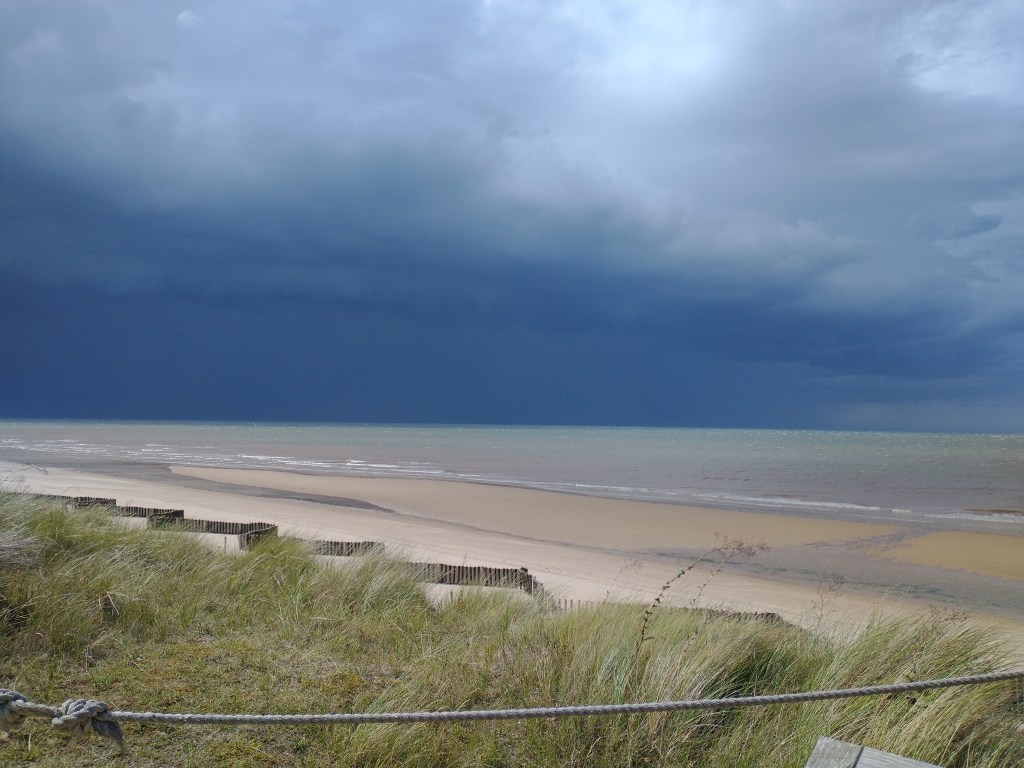
Research trip no. 2: The third thunderstorm of the day rolls in to destroy my tent.
This change in attitude has already made the project more enjoyable, but it took time to understand and implement it. Instead of a nimble about-turn, it felt rather like trying to make an aircraft carrier do a 180 degree turn through thick jelly. But finally, I’m listening to my subject, killing the darlings I was clinging to before, and allowing the writing to emerge. (I have a theory that there’s something about the lyric form that seeks to elide this sort of long attention in the writing, even as it demands it of the reader, but that’s an essay for another time.)
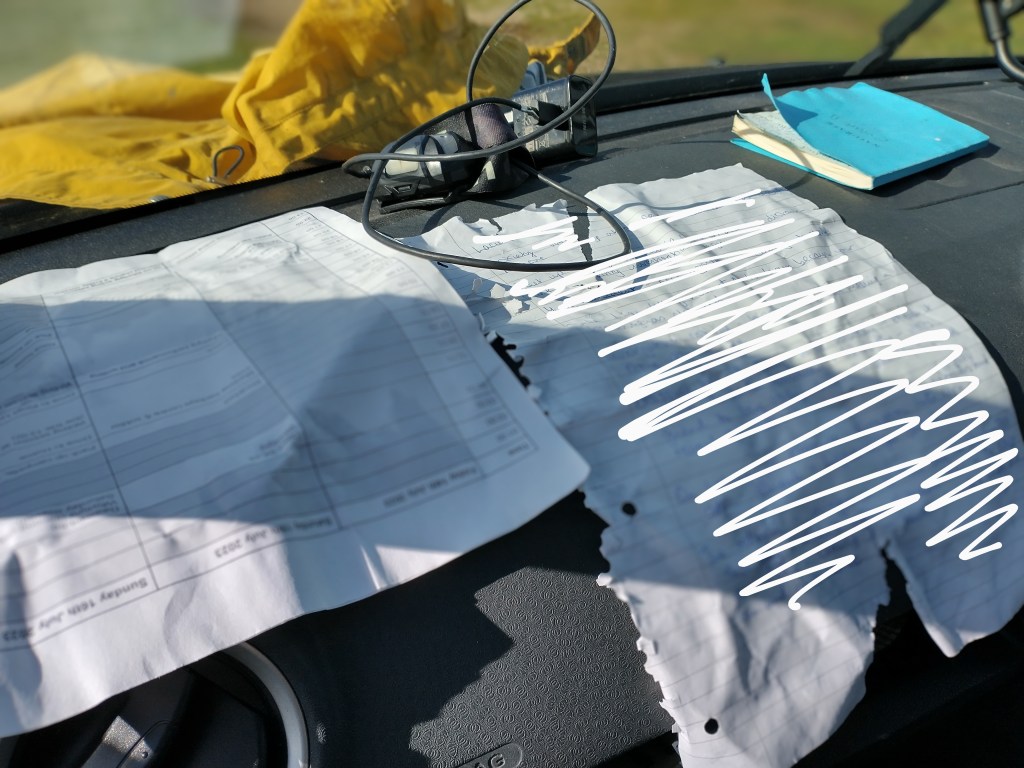
One of the key benefits of this approach is that I am more able to deal with setbacks. I had to postpone my second research trip to my site while I had COVID, and then once I got there again, I was camping in some of the most dramatic weather I’ve ever experienced. When one of my tent poles snapped and let heavy rain in to soak my spare clothes and even my notebook, I had to cut the trip short. Ordinarily I might have felt that incidents of this sort were thwarting the writing, but now I see that it’s all material.
This has been an important lesson for me to learn, and like all the best lessons it’s one I’ve been told many times by many different people, and only now do I fully understand what they meant. It’s what a friend tried to tell me in 2018 when he suggested I integrate my practice into a single output to save on energy. Later that same year another friend lent me their copy of Rachel Lichtenstein’s Estuary to show me that documenting the project can become the book itself. In 2019 I read Bhanu Kapil’s Ban en Banlieue, and many times since, and even the contents list is a lesson to “Write: the findings.” It’s the years of my visual art training to document process first and foremost. A coffee with my friend L earlier this year proved instructive when she advocated the importance to creative projects of time spent “staring at the wall”. It’s Sascha exhorting me to become a camera and “open the iris”. The process is the product.
Research trip 2: Drying out my notebook and itinerary after the tent disaster.
Now that I’ve finally joined all these dots, I see that my notes to self, itineraries that go unaccomplished, sick days when I wish I was well enough to write, and time spent staring at the wall can all feed the book. If I was writing a factual history of the Whirligig I’d be well off-piste by now, but I am trying to write about unhistorical time, about periphery and significance, about spheres of perception briefly and brilliantly overlapping and then diverging. Mishap and deferral are as much a part of the book as writing in situ at an appointed time.
So, the unwieldy aircraft carrier is back on course. I’m taking the summer to transcribe all I’ve written so far. And to try and try again to visit my site, and not be put off when it doesn’t work out. In the autumn, a new phase of the project begins and I’ll be upskilling in some different areas. But this bit, the middle of the project, is a time of renewed excitement and greater generosity to my past self, who hasn’t been doing nothing. Past me has filled notebooks, written for 10 hours a week since January, and most importantly of all, thought long and hard about how and why she still wants to share this place with other people through poetry. Now it’s just a case of following the why, and showing my workings.
It’s an exciting time in my ACE DYCP-supported project, CYMA. This week marks the final week of the research phase of the project. While I’ll continue to research my topics and relevant techniques throughout, this boundary marks a shift of emphasis: next week, writing becomes my primary focus.
In the field
At the weekend I undertook my first research trip, in which I travelled to the North Norfolk coast to do some site-specific writing and field recording on the salt marshes. The visit came at just the right time.
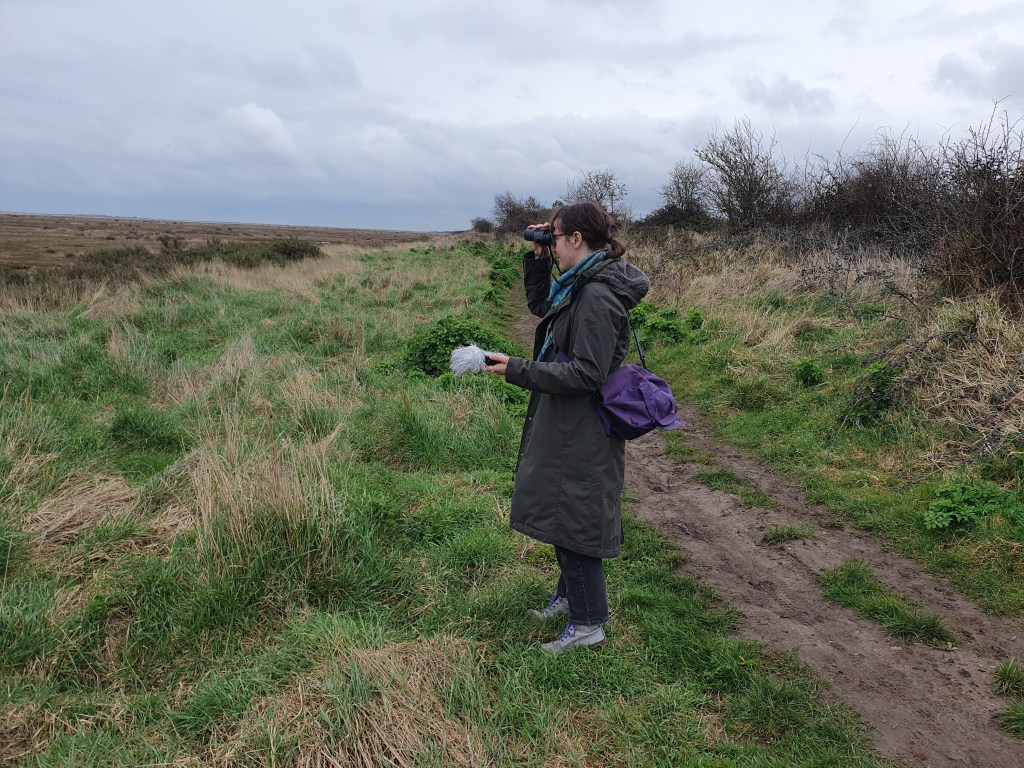
Recording in the field with a secondhand Zoom H4N Pro, 18 March 2023 (c) Flo Reynolds.
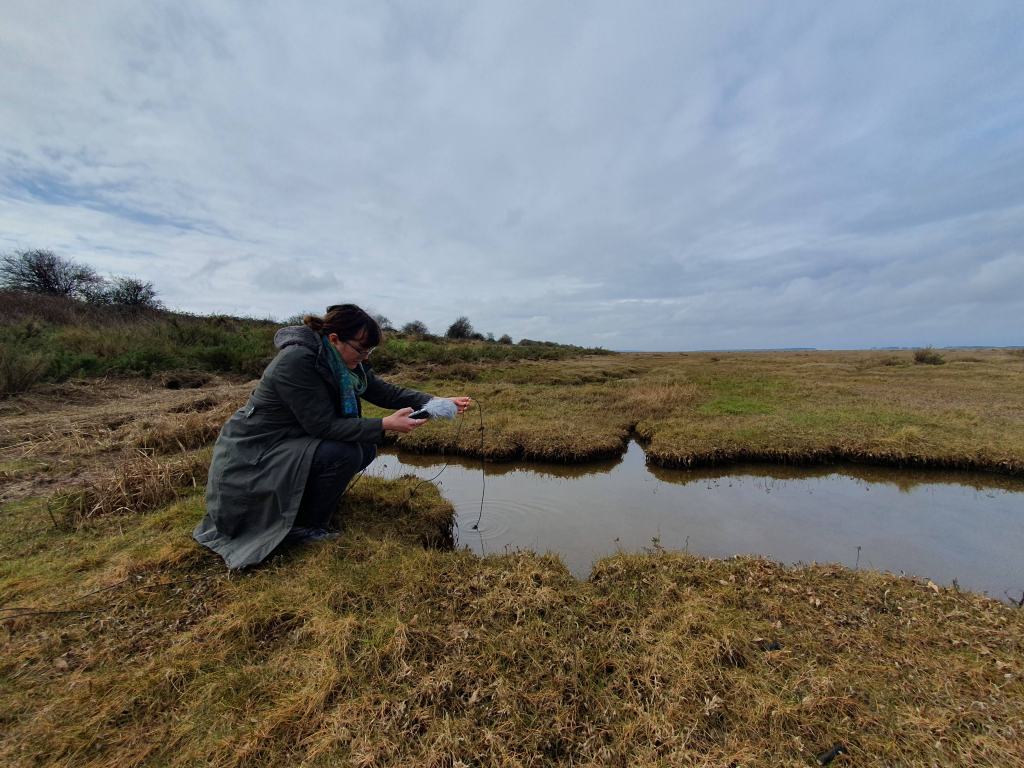
While much of my research phase has been about reading theories of sound, it has also meant getting to grips with my field recording equipment. I’ve been running tests – strange rituals involving water, a wheelbarrow, and walking over gravel – and met with sound designer, composer and musician Jonathan Baker to help me get the best out of my equipment.
The research trip represented a chance to put all I have learned so far into practice, and take my new methodology out into the field.
The Whirligig
I don’t remember how I came to settle on this landscape as a central part of the project – perhaps it’s in a notebook somewhere – but by 2020 when I wrote about scoping the project, I had already found the place I felt compelled to write about.
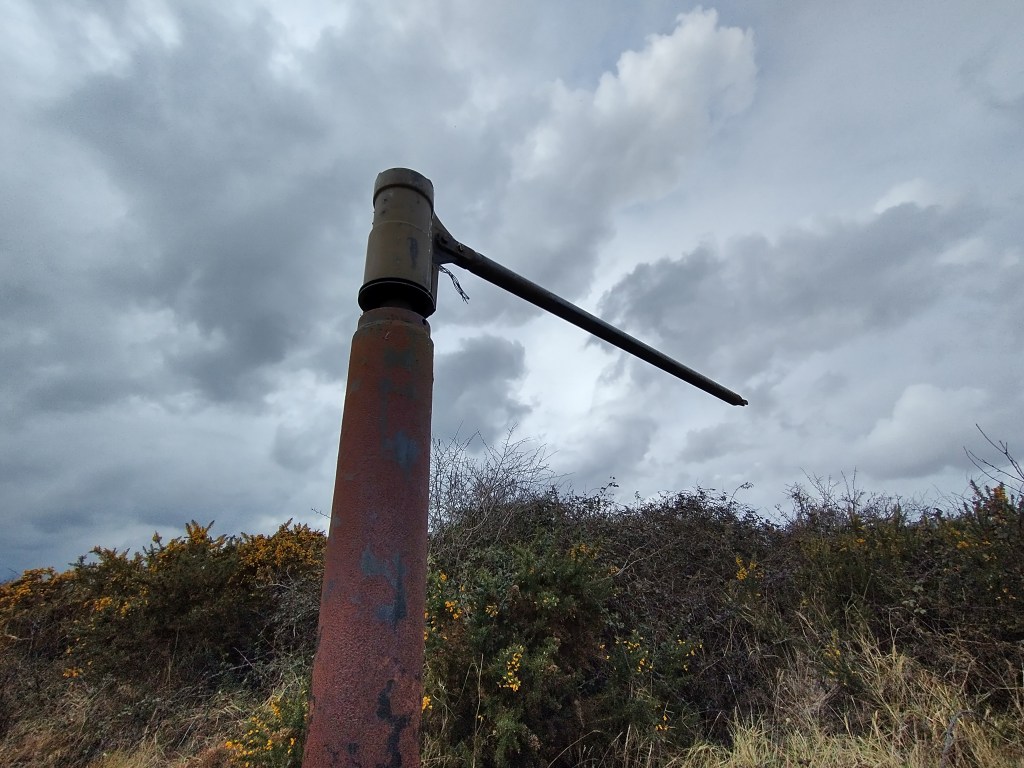
The Stiffkey Whirligig is a curious paved circle stretching out into the North Norfolk salt marsh, with a gallows-shaped metal pole at its centre.
The Stiffkey Whirligig radio arm, 18 March 2023 (c) Flo Reynolds.
The National Trust sign in the nearest carpark describes it as “a relic from the Cold War”; military history websites emphasise that it represents an early development in drone warfare from the Second World War, when many American troops were stationed nearby; and a friend local to the area tells me that it was once used as a sheep weighing station.
The metal arm is embossed with the name “Radioplane Company”; a quick Google search reveals that the company has Hollywood connections, having been founded by the actor Reginald Denny, and later employing a certain Norma Jeane Dougherty.
Waves of stories
I’m less interested in the precise military use of the radio arm, although the vision of small balsa wood aeroplanes being hammerthrown from it, shot at by practicing troops, and then crash-landing on the saltmarsh, is an arresting image. More, it’s the overlapping and occasionally contradictory stories of the site which interest me.
There’s a sense of waves of different relationships between place and people along this coastline, echoing into history through stories of 19th century smuggling, through the Hanseatic League of the Middle Ages, through Roman Britain, and beyond… after all, Seahenge and Holme II were discovered just a few miles down the coast.
Taking a hydrophone recording in a pool at Stiffkey Marshes, 18 March 2023 (c) Flo Reynolds. I ensure my equipment is clean and washed before use to help prevent the spread of invasive species and harmful chemicals.
Today this coastline is home to the last few fishing boats, luxury second homes, and stand-up paddle board tours of the creeks. Beneath all of this, the salt marsh has been a fluctuating constant. It is an ecologically rich landscape, neither fully land nor water. In light of the climate and extinction events to come, it looks increasingly fragile.
This is the landscape I have been fascinated by since I first visited in 2017, and where I first started practicing listening exercises in 2018. It’s where I now continue these practices, where I write in situ, and where I try to capture the sounds and stories of the marsh in all their variety.
Writing live vs. writing the recording
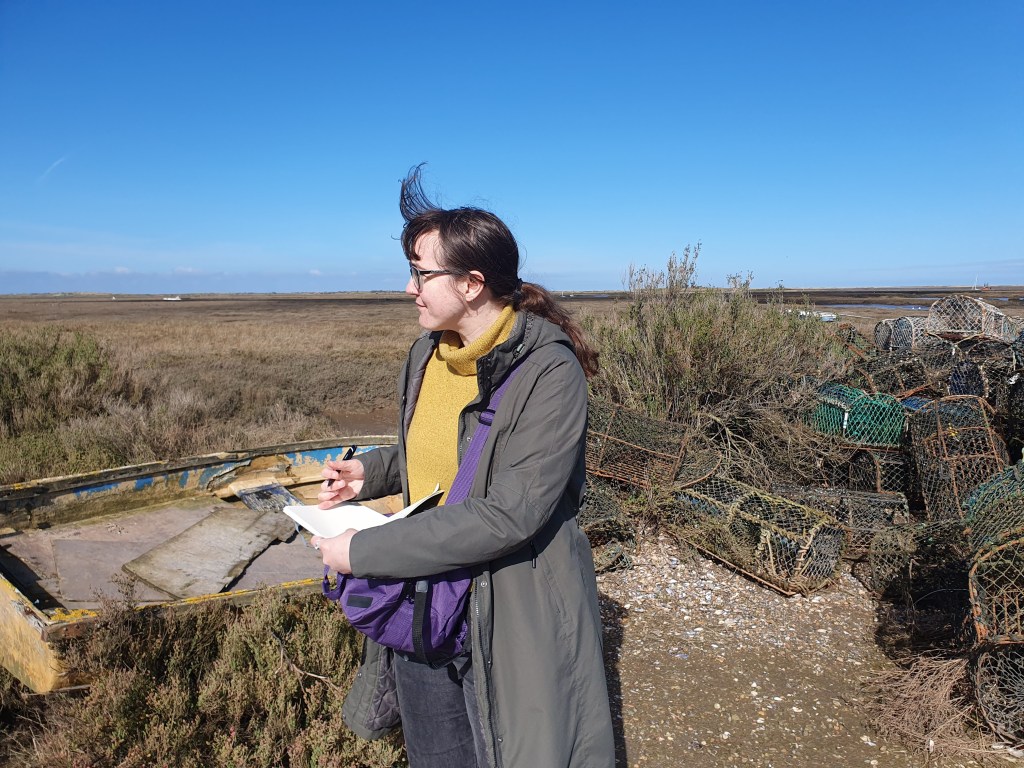
Following the research trip, I now have pages of notes to work with, and many field recordings to listen back to, write from, edit into presentable shapes. One thing I’m particularly keen to compare is writing live versus writing from a recording – do any differences come through in the writing?
Live writing on the windy Norfolk Coastal Path, 18 March 2023 (c) Flo Reynolds.
I spent hours on the marsh trying to get the perfect recording of a curlew’s call despite the wind, tapping the radio arm while stethoscoping it with a contact microphone, dipping a hydrophone into its pools and creeks. What do these recordings say of the place they originate from, while I’m back in my Norwich box room, trying to craft a successful pantoum? What might my eventual reader hear of them?
All of these questions, and more, are to be explored as I come at last to synthesising my research, and setting down to write.
I’m into the research phase of my ACE-funded poetry project (working title CYMA) and wanted to share the many brilliant sources that are inspiring and informing me along the way. I’ll update this list over the course of the project.





 Flo Reynolds