This year I founded Vessel, a new indie zine exploring poems as containers. Joining me to guest edit issue one is my long-time collaborator and friend Cat Woodward. As the submissions window for issue one draws to a close (23:59 BST on 28 August – more info here) we thought we’d do a short podcast about Vessel, the poems we love and what Cat will be looking for from the submissions we receive.
You can now listen to the podcast here and read the transcript over on the Vessel site. We talk about “open” poems, having a dig around inside words, and the spirit of Ursula Le Guin’s Carrier Bag Theory.
While I regularly interview authors for The Writing Life podcast, this is the first podcast I have produced and edited by myself and it has been a great learning curve. I can’t wait for the next episode in this very occasional podcast series, which will be in a few months time with the guest editor of issue 2… to be announced!
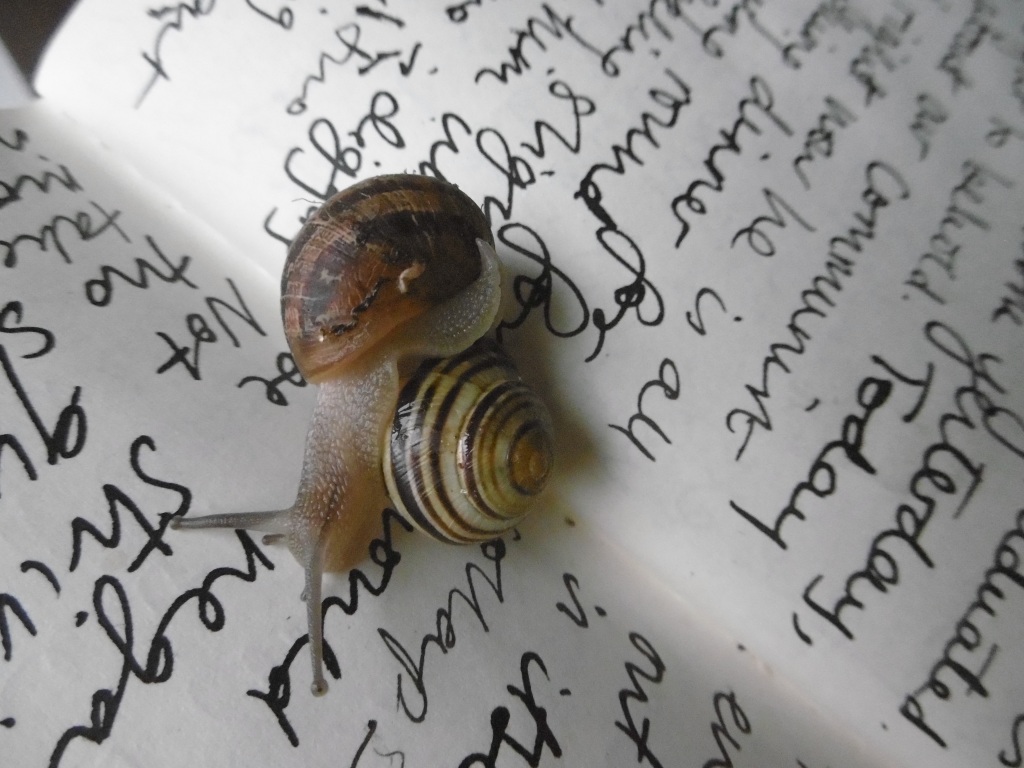
Over the last few weeks I’ve been revisiting a project that I undertook in 2014, in which I collaborated with snails.
I noticed that after periods of summer rain, the gravelled front garden of the house where I was living with friends would come alive with snails. I remember that summer as one of warm rain, grass flowers, and slow mornings drinking lots of black coffee with my friend Meg.
At that time, I had just started keeping a notebook again after a few years of being without a daily writing practice. It occurred to me to try bringing literature and snails together to see what would happen. I did this by taking my notebook outside, and placing snails upon it, and then repeating the experiment indoors, to see if anything changed.
It was fascinating to observe them – they way they moved around, towards and away from one another; the variations in colour and pattern on their shells; the patterns they formed on the page. Most interesting to me was the way they interacted with the paper itself. Outside, almost all of the snails slid off the page and away into the gardenafter a short while, leaving very little trace that they had ever been there. The couple that I brought indoors started to chew the paper, and their munching was surprisingly loud and powerful. These snails did leave the marks of their presence, either biting through a few layers but leaving the page intact, or creating a hole in my ink-scribbled pages. After a while, I removed the snails and replaced them in the garden to go about their days as if nothing much had happened.
To document this process I took photos on my phone. They weren’t of fantastic quality, but gave a nice sense of the snails interacting with the paper, capturing their tentacles fully extended and the translucency of their bodies. Later, I would go on to use one of these images in my poem “Song for a lisp” (a version has been published in The Interpreter’s House, along with two of the photos from 2014). I’ve also referred back to this experiment as part of my ongoing “Compost poems” project.
In “Song for a lisp” I call this experiment “an ecoliterary intervention”, with a wink and a nudge. Having trained myself out of lisping over many years, I had wanted to write myself a tongue-twister that would undo that training and release my voice as it was/is, without the internalised social pressures and shame that too often accompany having a speech impediment. The visual experiment with the snails eventually connected with my writing about tongues (both physical and as languages). Initially wanting to explore physical similarities in texture of the tongue and the snail’s foot, I realised that the snails also helped me to employ a certain faux-academic, formally observant register in the poem, which is about mistakes, slippages and speech impediments. Using a mock-serious, verbose and procedural register allowed me to sit the poem in that space of training/being taught whilst also undermining it, letting out something freeing, uninhibited, and “incorrect”. My hope is that the effect would enact mistakes and impediments as a valid means of aquiring and communicating knowledge, and one that opens up the potential for play, irreverence, trying things out, and collaboration (even with other life forms).
Now that my first pamphlet will be published in 2021, and is currently being typeset and possibly illustrated, it has been fun to repeat the experiment in the hopes of getting some photos of higher, printable quality. I’m still working through this process, making plenty of mistakes and slip-ups, but am enjoying it and wanted to share a few of the new photos.
The submissions window for issue 1 of new, independent poetry magazine Vessel is now open until 23:59 on 28th August 2020.
Poets can send up to 4 poems and/or images for consideration to vesselpoetry@gmail.com. Full submissions guidelines and more about the editorial process can be found here.
Issue 1 is edited by Flo Reynolds and Cat Woodward.
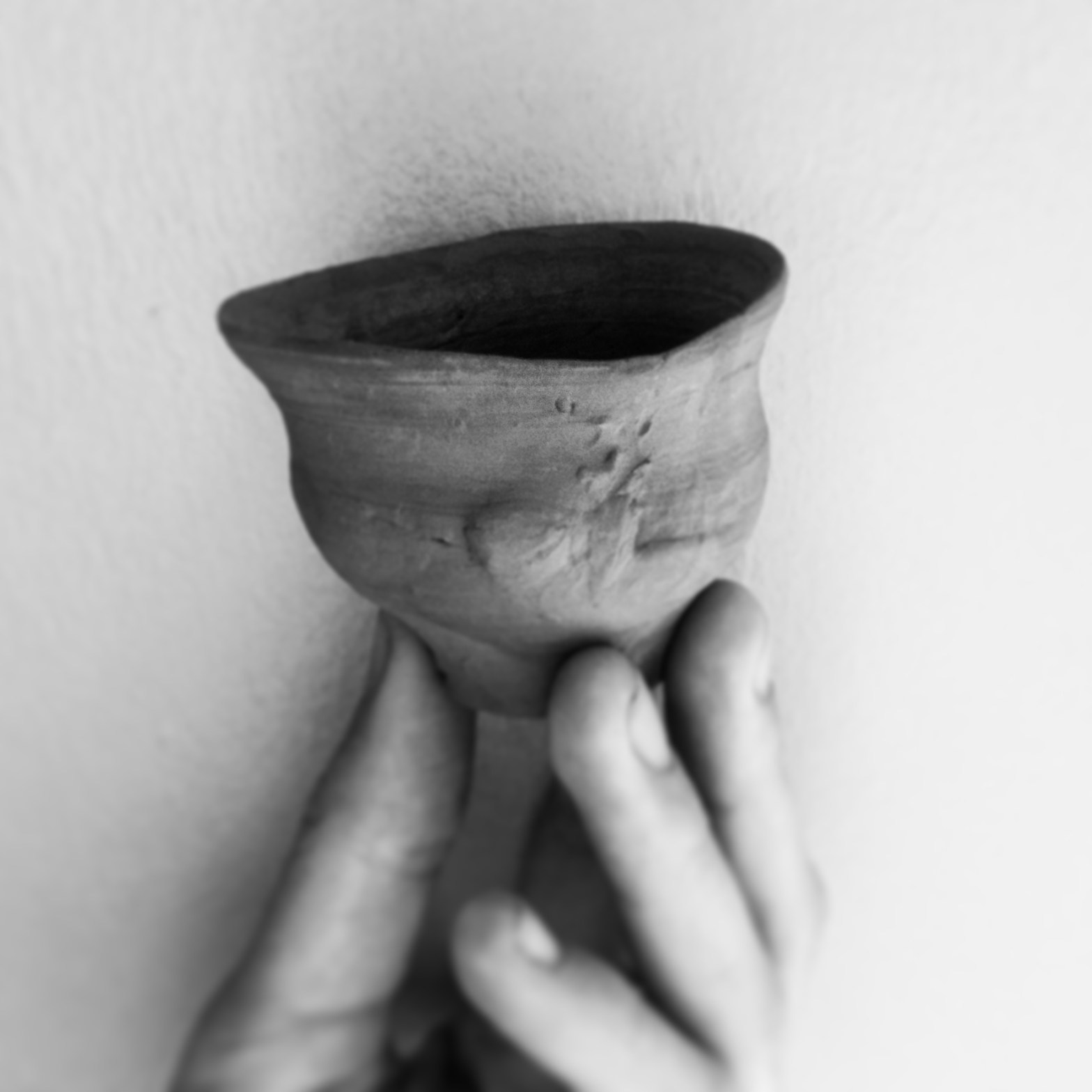
After a couple of years of thinking about it, I have launched Vessel, a new independent magazine exploring the ideas of poems as vessels.
Inspired in part by an interest in material culture and by Ursula K. Le Guin’s “Carrier Bag Theory of Fiction”, Vessel will explore, both formally and thematically, what a poem might hold, what might slip through it, and how it might contain.
There will be two DIY-printed issues per year, with a rolling co-editorship model. My longterm collaborator Cat Woodward will be joining me to co-edit the first issue.
Vessel will be seeking submissions of poems and images from 1st July 2020. You can find out more here, and read the submissions guidelines here. All enquiries and submissions can be sent to vesselpoetry@gmail.com.
My poems “the other body”, “houseplants” and “still life with mangelwurzel” have been published today in Anthropocene poetry journal. Big thanks to Charlie and the Anthropocene team, and I hope people enjoy reading them. You can do so here.
Back in October I had the pleasure of speaking to poet Kendel Hippolyte during his UK tour for the release of his latest collection, Wordplanting. We spoke about writing across different forms and the responsibilities that writers have towards their art and their reader. Click here to hear more.
I really enjoyed the chance to interview Cat Woodward for NCW’s The Writing Life podcast a few months ago, and the episode has gone live today. Cat was in Norwich to read at UEA Live just before the launch of her latest collection Blood. Flower. Joy! (Knives Forks & Spoons, 2019) so we caught up about treating your writing as a defined project, the editing process, and how Cat articulates her concerns and interests as a writer in everything she does. Listen now.
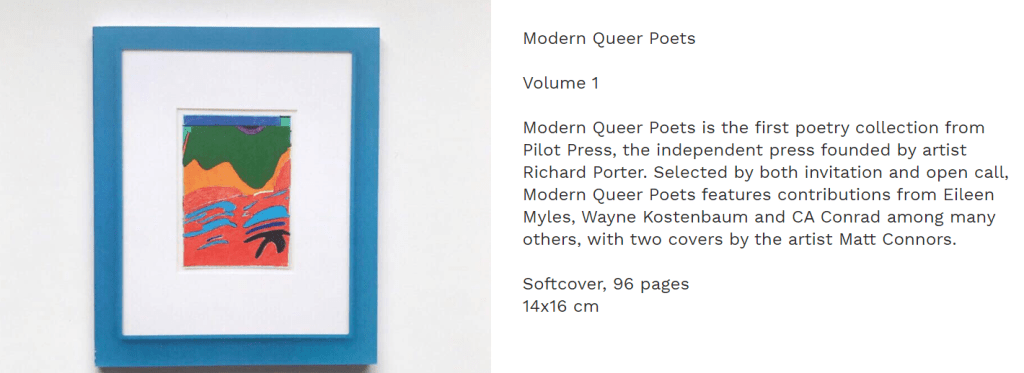
I’m delighted to have two poems in the first Modern Queer Poets anthology by Pilot Press, edited by Richard Porter. The poems are “the reading” (a take on my recurrent themes in my manuscript, holon) and “I’m a riddle and you’re working me out”, which is older. I’m so glad it has finally found a home, and alongside some of my favourite poets writing today (Eileen Myles! CA Conrad!) to boot.
The anthology is currently available half price in a flash sale via Richard’s website.
I’ve recently finished the poems for my first collection, holon. And while I edit the collection, and find suitable afterlives for those poems, I’m also starting to think about a new project: for now, until it coalesces, I call it ‘that listening space’.
I will use listening as both theme and methodology, and in a spatial/environmental as much as aural sense. I hold listening as a kind of spatial receptivity, and it’s this that I’ll be exploring in the new project. At the moment I’m reading Pauline Oliveros and Gaston Bachelard, but there are many thinkers, writers and artists whose work I’ll draw on, in addition to field research and lived experience (I am ‘hard of hearing’ – as if hearing were a surface, as if I am somehow calcified).
‘That listening space’ feels like a natural continuation of the themes (of bodies, solidarity, lost childhood/ancestral languages and materialisms) that I explored in holon, as well as the chance to push myself with new techniques, new forms, and new ways to research. I’m excited to start deciding the aims and scope of the project, the resources and ways of working I need to make it happen, and just what form it might take.






 Flo Reynolds