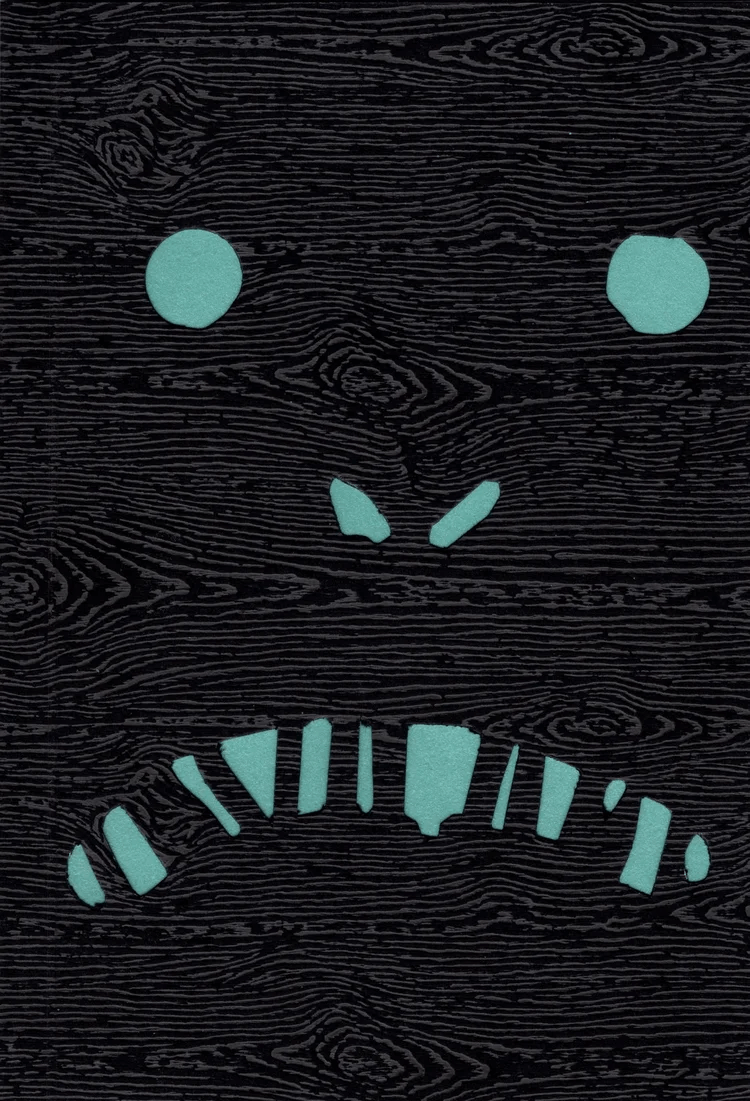
It’s a couple of months since the launch of my third poetry book, peel me Watcher, out now with Guillemot Press. I’ve had a lot of fun sharing it with readers either side of Christmas, and it’s been heartening to see it continue to find new people. I deliberately took the first weeks of the year very gently, and now it feels like the right moment to step back into talking about the book more publicly.
peel me Watcher took twelve years to write, which means I’ve had a long time to sit with what it’s trying to do, and with my own doubts about whether it should exist at all. It’s experimental, and probably my biggest creative risk so far. That makes me nervous, but it also makes me excited to talk about how it came into being, and about the questions that kept me returning to it over such a long time.
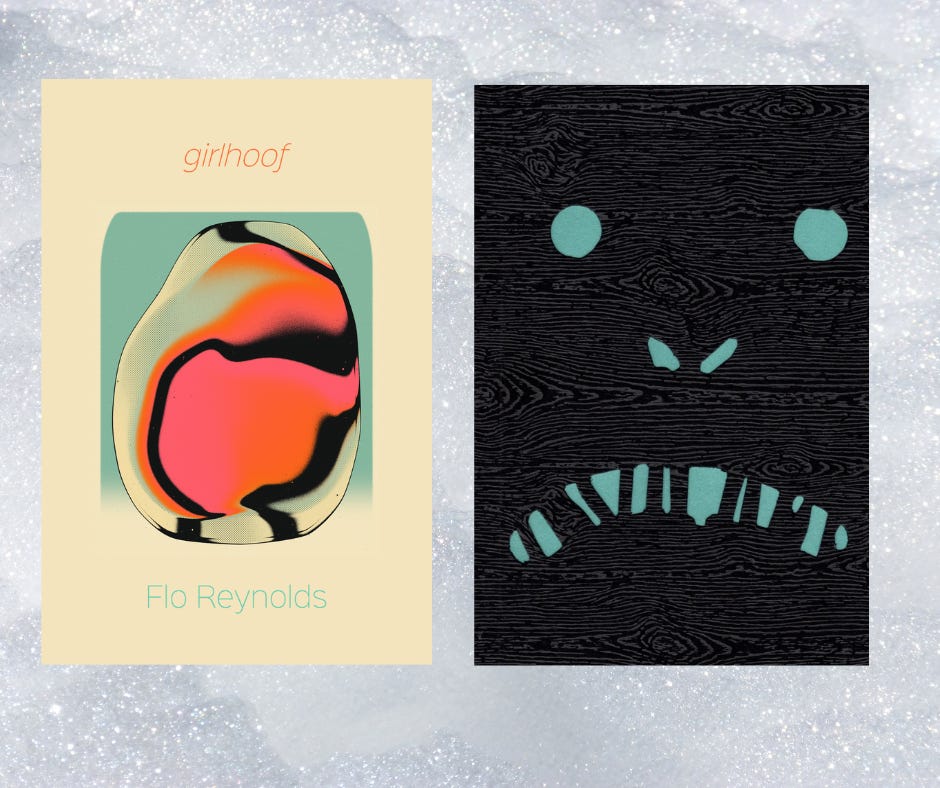
It’s also pleasing to have something new to hold up, because my previous chapbook, girlhoof, is now out of print. Its micro-publisher, the wonderful Salo Press, sold out two print runs, and now it’s time for them to focus on some other titles. I ran into Sophie, the Salo editor, recently, and she told me that when people asked for “the weirdest thing” on their list, girlhoof was the obvious recommendation. I’ll happily take that compliment. If you got a copy, well done, because there will be no more, for now at least.
So: farewell girlhoof, and hello peel me Watcher.
It started in an art gallery
In peel me Watcher, the speaker enters an art gallery and becomes transfixed by a work of art that begins to unsettle their understanding of the world, and of their place in it.
The premise is based on a true story. When I started writing the poem in 2011, I’d recently left home during a difficult time. I spent hours in a local art gallery, which was free to visit. The quiet helped, the art helped. As a child I had always drawn and made art, and here I could connect with some essential part of myself despite my turbulent circumstances.
One artwork, in particular, held me: a mask made by Yu’pik artist(s) in the nineteenth century. I’d never seen anything like it before, coming from my small provincial hometown. It didn’t fit the Western ideas of ‘beauty’ I’d unconsciously absorbed, but it was without doubt beautiful. Displayed in a gallery alongside works by Degas, Francis Bacon and Giacometti, it was anonymous. I loved it.
I wanted to know more, so I looked it up in the catalogue. Very little was recorded about its provenance. There was a gap of over a century between its making in Alaska and its appearance in England in the 1970s. We know what that gap means. This object was unlikely to have arrived here through fair and equal exchange.
This knowledge troubled me. I was aware that I was benefiting from the mask’s presence in my life, thousands of kilometres from its community of origin. I was comforted and stirred by it, to the extent I wanted to write about it. But that inspiration was inseparable from dispossession, and that dissonance became part of the poem’s problem.
Just because you can, doesn’t mean you should
Over the next decade, I returned to the poem and the gallery again and again, trying to make a good poem about the mask. I sent versions out to journals, and they were, rightly, rejected. The poem felt clumsy and unresolved, and I began to suspect that this wasn’t only an issue of technical skill. I worried that by writing about the mask at all, I was crossing an ethical line. Can I write this? And more to the point, should I? Was I writing from my own position, or projecting onto someone else’s culture? Had I examined my own drives closely enough to continue with a clean conscience?
These questions widened into something bigger, and more uncomfortable. How do we talk about things or people without appropriating or instrumentalising them? How do we leave space for others to speak for themselves, not least in a poem? Once I started looking, I saw how often we speak on behalf of others. Couples speak for each other, parents speak for their children, employees for their employers, organisers for their community groups, fans for public figures and even fictional characters. Sometimes it’s protective, sometimes it’s strategic, sometimes it’s about belonging. We do it all the time, and it’s all around us.
Poetry has an easy hiding place when it comes to the question of appropriation, which allows us to have our cake and eat it: the lyric I. Poems are often misread as personal confessions by the poet, with readers imagining that the poet must be writing from their own lived experience. On the other hand, the poet can get out of almost any corner imaginable by explaining that ‘it wasn’t me, it was the lyric I, which isn’t me’. We can claim both sides as it suits us, in a way that writers of fiction and non-fiction can’t. Ours is a slippery art.
The breakthrough
Two things shifted the work. One was the gradual reframing the poem away from the object, and towards my own experience of divergent attention and its linguistic and structural effects. The other shift came suddenly. One morning I woke up knowing that the poem wasn’t about describing the mask at all, but about positionality: where I stand in relation to what I’m looking at, in space, in time, in power dynamics. What happens if the thing I’m observing is also watching me? What if it has its own agency, its own view of what’s taking place between us?
In English, position is largely expressed through prepositions, and that’s where the poem finally began to move. By working outwith, foreto, inhwards and hithere, I could make the poem stop trying to speak for the mask, and start circling the conditions of encounter instead.
Through a short residency, winning a prize draw for a discounted manuscript reading, and a lot of patient listening, the poem gradually cohered into the strange, questioning text that became peel me Watcher. Some of its early readers enjoyed its likeness to the labels you see next to art works in a gallery, and the way the strange words suddenly make sense when read aloud. Others felt it was too much, too inconsistent, too difficult. But I knew I was onto something. Divergence and difficulty stopped feeling like problems, and became practical tools for thinking about relationship. They’re a way to not collapse difference, to stop pretending that difference isn’t there.
I still feel uncomfortable about sharing the poem, and I think that discomfort is part of its ethics. I’m not making money from it, and that’s important. But more importantly, I want the work to be open about its own limits. Writing, like looking, is a form of projection. For many (not all) of us, our development is shaped by watching our carers’ faces, and by seeing ourselves in a mirror, and later by seeing ourselves in a character in our favourite story. As adults, we aren’t much more complex. Often we like to see ourselves reflected, including in other people. Naming that impulse, and the events and structures it has led to, and the ways we try and avoid acknowledging it, is what makes this book itself.
peel me Watcher isn’t a neat answer, and so it can’t be a neat poem either. My early readers were right – it is too much, too inconsistent, too difficult, and that’s the point. And yes, it masquerades as a series of exhibition labels, and it sounds its sense. And yes, it plays on masking, in the neurodivergent sense.
It’s also a record of sitting with a problem for a long time, and of letting that problem shape the form of the work. Through writing it, I’ve learned that, if in doubt, look to the form. The question you are looking for may be there.
peel me Watcher is available from Guillemot Press – you can get your copy here.
This post was originally published on my Substack, Read Write Grow.
 Flo Reynolds