I’m in the middle of my CYMA project, and remembering that middles can be hard, can’t they? We’ve all been there: the initial enthusiasm has been spent, there’s the sense that time is running out, and still you don’t feel like you’re anywhere near finishing. In a writing project, the middle is so often where doubts start to creep in and cause blocks. In my case the blocks have been physical and creative. The physical block was catching COVID at the end of May, and it took about six weeks to fully recover. The creative block was also a breakthrough, but it took its time about percolating through fully.
Following my first session with my mentor, Sascha A. Akhtar, I realised that I have been writing this project in a way I believed I ‘should’ write it, rather than in a way that is true to me, my process, and my subject. Sascha was able to communicate this to me in the first five minutes of our meeting, which was incredible to me after months of trying to force my writing down a misguided route. With Sascha’s guidance I’ve been able to start allowing myself to be led to an emergent marriage of form and content. This is how I usually write; I generate loads of material in enormous blocks of text, and then whittle it down into what will hopefully be a sharp, shining nugget. It can be slow work, but it works, and I didn’t need to abandon this method for the new project.
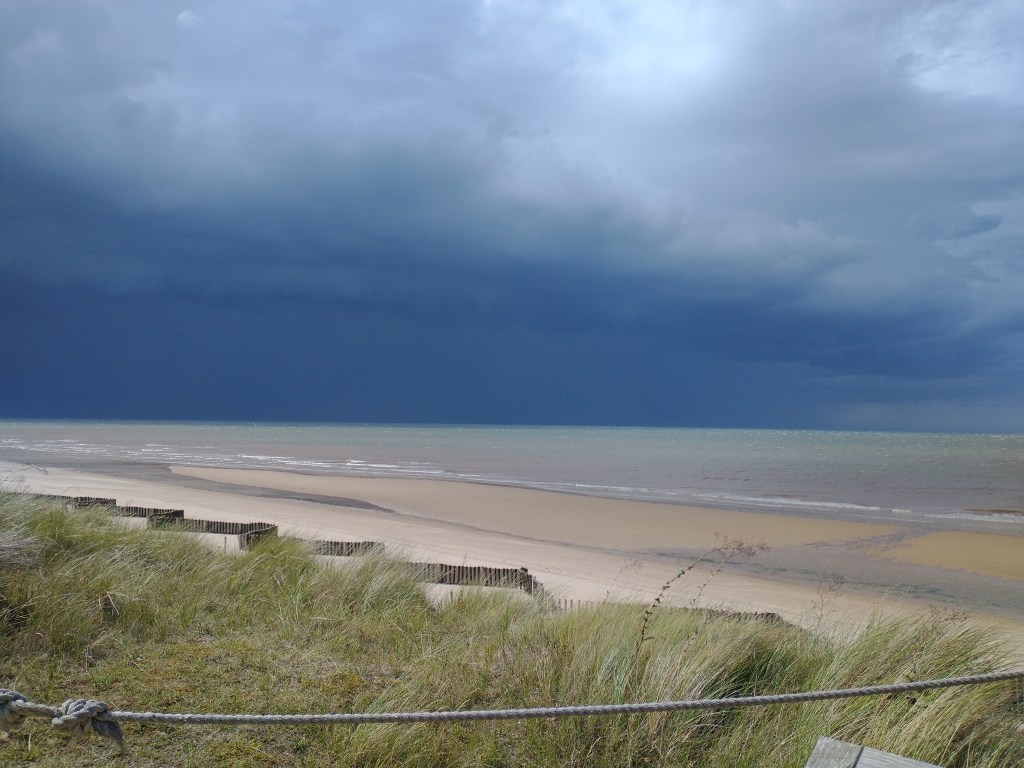
This change in attitude has already made the project more enjoyable, but it took time to understand and implement it. Instead of a nimble about-turn, it felt rather like trying to make an aircraft carrier do a 180 degree turn through thick jelly. But finally, I’m listening to my subject, killing the darlings I was clinging to before, and allowing the writing to emerge. (I have a theory that there’s something about the lyric form that seeks to elide this sort of long attention in the writing, even as it demands it of the reader, but that’s an essay for another time.)
One of the key benefits of this approach is that I am more able to deal with setbacks. I had to postpone my second research trip to my site while I had COVID, and then once I got there again, I was camping in some of the most dramatic weather I’ve ever experienced. When one of my tent poles snapped and let heavy rain in to soak my spare clothes and even my notebook, I had to cut the trip short. Ordinarily I might have felt that incidents of this sort were thwarting the writing, but now I see that it’s all material.
This has been an important lesson for me to learn, and like all the best lessons it’s one I’ve been told many times by many different people, and only now do I fully understand what they meant. It’s what a friend tried to tell me in 2018 when he suggested I integrate my practice into a single output to save on energy. Later that same year another friend lent me their copy of Rachel Lichtenstein’s Estuary to show me that documenting the project can become the book itself. In 2019 I read Bhanu Kapil’s Ban en Banlieue, and many times since, and even the contents list is a lesson to “Write: the findings.” It’s the years of my visual art training to document process first and foremost. A coffee with my friend L earlier this year proved instructive when she advocated the importance to creative projects of time spent “staring at the wall”. It’s Sascha exhorting me to become a camera and “open the iris”. The process is the product.
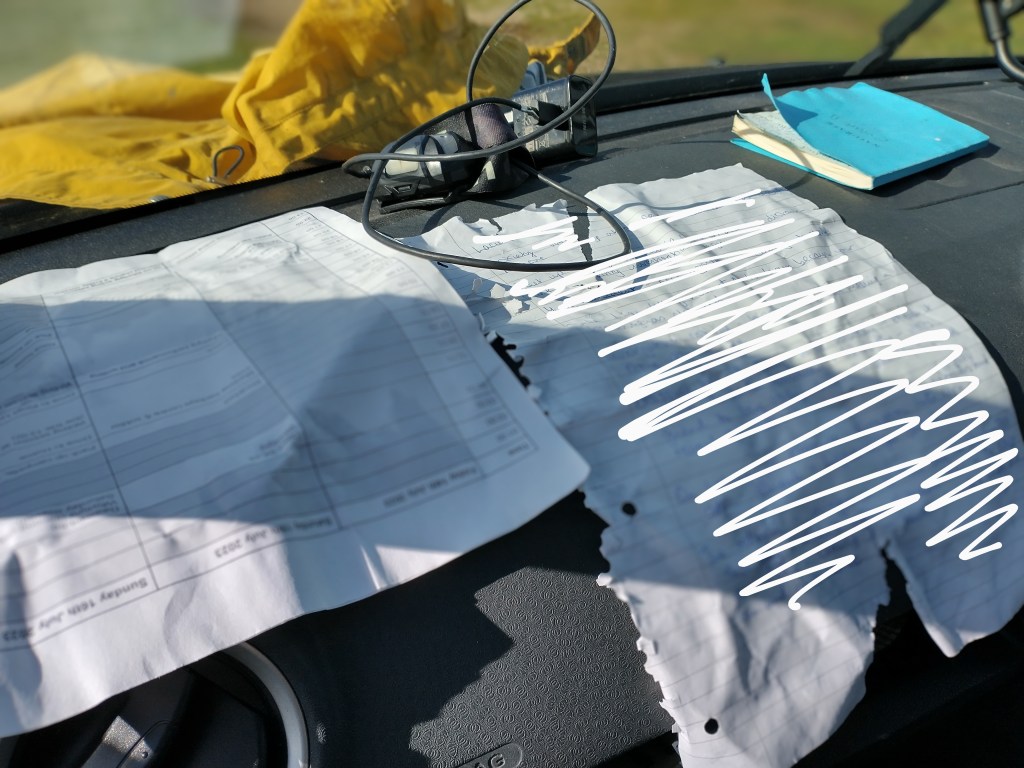
Now that I’ve finally joined all these dots, I see that my notes to self, itineraries that go unaccomplished, sick days when I wish I was well enough to write, and time spent staring at the wall can all feed the book. If I was writing a factual history of the Whirligig I’d be well off-piste by now, but I am trying to write about unhistorical time, about periphery and significance, about spheres of perception briefly and brilliantly overlapping and then diverging. Mishap and deferral are as much a part of the book as writing in situ at an appointed time.
So, the unwieldy aircraft carrier is back on course. I’m taking the summer to transcribe all I’ve written so far. And to try and try again to visit my site, and not be put off when it doesn’t work out. In the autumn, a new phase of the project begins and I’ll be upskilling in some different areas. But this bit, the middle of the project, is a time of renewed excitement and greater generosity to my past self, who hasn’t been doing nothing. Past me has filled notebooks, written for 10 hours a week since January, and most importantly of all, thought long and hard about how and why she still wants to share this place with other people through poetry. Now it’s just a case of following the why, and showing my workings.
 Flo Reynolds